
22-23 September 2026
Aristotle University of Thessaloniki, Greece
It is with great pleasure that we welcome you to the final General Meeting of the ACRYRED COST Action in Thessaloniki, Greece!
Hosted by the Aristotle University of Thessaloniki under the auspices of the School of Chemistry, this two-day event will showcase overviews of activities through dedicated sessions led by each Working Group, as well as poster presentations from Early Career Researchers.
We look forward to a dynamic closure to this successful and productive COST Action!
Download proceedings here.
Local Ogranizing Committee
Adamantini Paraskevopoulou, Professor (Aristotle University of Thessaloniki, School of Chemistry)
Maria Papageorgiou, Professor (International Hellenic University, Department of Food Science and Technology)
Kali Kotsiou, Assistant Professor (International Hellenic University, Department of Food Science and Technology)
Maria Kopsacheili, PhD Candidate (Aristotle University of Thessaloniki, School of Chemistry)
Sofia Keramari, MSc (Aristotle University of Thessaloniki, School of Chemistry)
Core Group Members
Nigel Halford, Action Chair, WG1 Leader, Rothamsted Research, United Kingdom
Neil Buck, Action Vice Chair, Grant Holder Scientific Representative, ILSI Europe a.i.s.b.l. BelgiumMałgorzata Starowicz, Science Communication Coordinator, WG1 Co-Leader, InLifeInstitute of Animal Reproduction and Food Research, Poland
Kristina Kukurova, Grant Awarding Coordinator, National Agricultural and Food Centre, Slovakia
Elena Baldoni, WG2 Leader, IBBA-CNR National Research Council, Italy
Viktor Korzun, WG2 Co-Leader, KWS SAAT SE & Co. KGaA, Germany
Jane Parker, WG3 Leader, University of Reading, United Kingdom
Christine Nowakowski, WG3 Co-Leader, University of Minnesota, United States
Tanya Curtis, WG4 Leader, Curtis Analytics Ltd., United Kingdom
Meleksen Akin, WG4 Co-Leader, Igdır University, Turkey
Zuzana Ciesarova, WG5 Leader, National Agricultural and Food Centre, Slovakia
Vural Gökmen, WG5 Co-Leader, Hacettepe University, Turkey
Venue
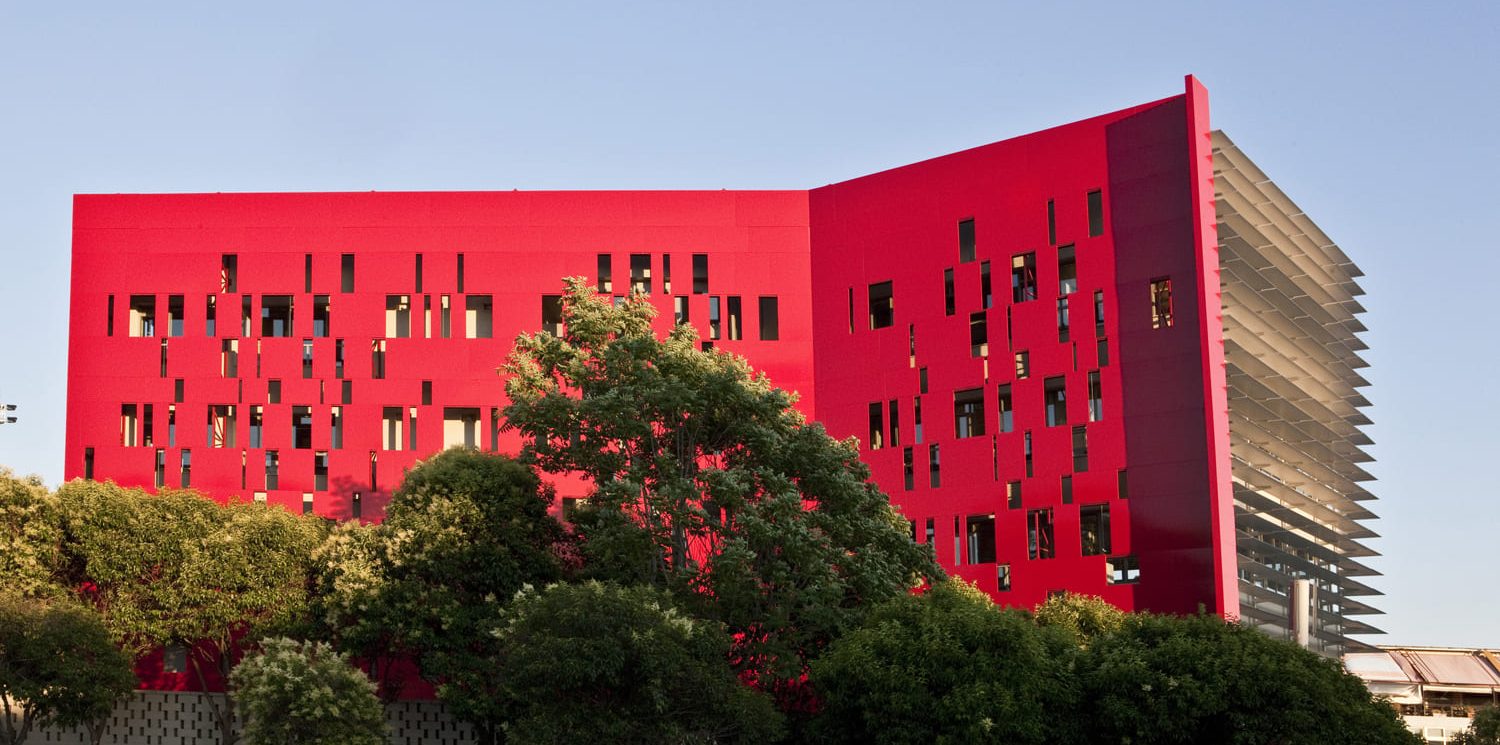
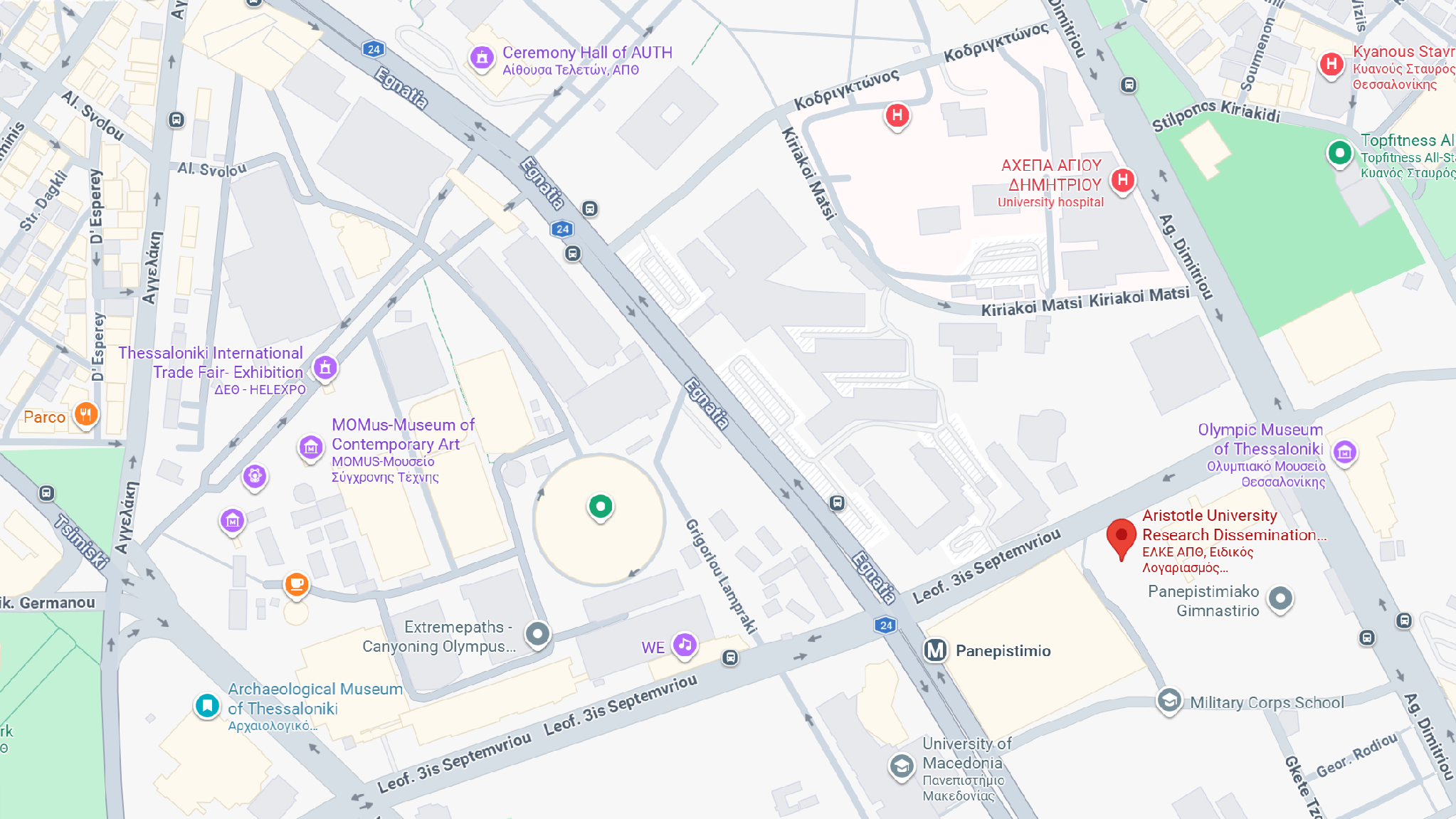
The Meeting will take place at the Aristotle University’s Research Dissemination Center (KEDEA), located downtown, on Tritis Septemvriou Ave. at Aristotle University’s campus between the Student Club and the University Gymnasium. An important element of the architecture of the building is the characteristic red color. The meeting will take place in amphitheaters II & III, located on the Basement level (-1).
Internet Access
Wireless internet and eduroam are available in the AUTH Campus. More information will be given during the event.
To Reach the City/Venue
From Thessaloniki Airport “Makedonia” to the center of the city
The airport “Makedonia” in Thessaloniki is located 14 km out of the city. A public bus service is available 24 hours a day from the airport to the city centre and the journey takes about 40 – 50 min. Tickets cost 2 € one-way and can be bought on the bus or deducted directly from your bankcard.
Non-stop service to and from the city centre:
- Bus Route No. 01X “KTEL – Airport”
- Bus Route No. 01N “KTEL – Airport” (Night Service)
For more information, please click below:
https://www.skg-airport.gr/en/flights–more/airport-information
https://maps.app.goo.gl/mdzfkkoysh7mqoEQ8
Taxis are also available at any time (25-30 €). A double fare is applicable between midnight and 05:00 am
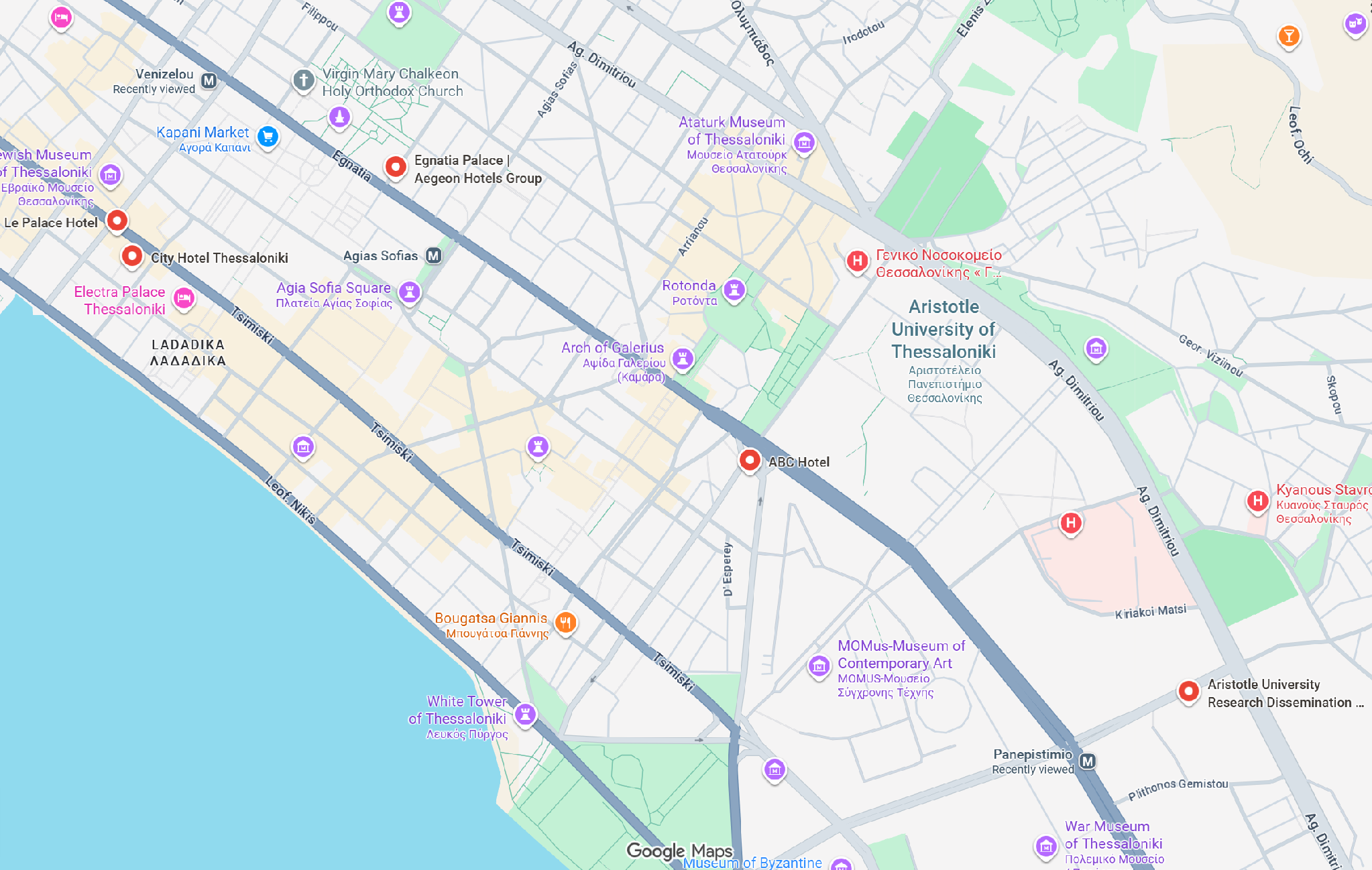
Please, note that the metro currently does not connect the airport with the city center, but you can take the metro to reach KEDEA from various parts of the city by getting off at the “Panepistimio” station (https://www.thessmetro.gr/en/). If you prefer, you can also walk directly from your hotels (from 10 to 30-min walk) or take the local buses. The standard ticket for both the bus and the metro is 0.60 €.
The KEDEA building is connected with the following bus lines (https://oseth.com.gr/en/):
02K, 14A, 58 Bus Stop University of Macedonia
17, 24, 37 Bus Stop Fititiki Leschi
10, 31 Bus Stop Agia Foteini- University of Macedonia
27, 28, 83 TS Panepistimia
The KEDEA building is connected with the following bus lines (https://oseth.com.gr/en/):
02K, 14A, 58 Bus Stop University of Macedonia
17, 24, 37 Bus Stop Fititiki Leschi
10, 31 Bus Stop Agia Foteini- University of Macedonia
27, 28, 83 TS Panepistimia
Accommodation
1. Hotel ABC www.hotelabc.gr
2. Egnatia Palace www.egnatiapalace.gr
3. City Hotel Thessaloniki https://www.cityhotel.gr/
4. Le Palace Hotel https://lepalace.gr/
Updated Programme
Tuesday, 22 September 2026
Morning – Core Group Session 10:00 – 12:00
- Action Chair Opening
- Core Group Session and Approval of the MC Agenda
On-line: CG meeting online
Afternoon – Management Committee Session 14:00 – 17:00
- Action Status – Nigel Halford
- Budget Status – Ruchi Pragnesh Shah
- WG Status and Summary of Activities – WG Leaders
- Grant Status – Kristina Kukurova
- Communication Status – Małgorzata Starowicz
On-line: MC meeting online
20:00 – Social Dinner
Wednesday, 23 September 2026
General Session
Link for on-line participation: GM online
| 08:30 – 09:00 | Registration | |||
| 09:00 – 09:05 | Nigel Halford | UK | Introduction, Overview | |
| 09:05 – 10:00 | WG1 Activities and Outcomes | |||
| 09:05 – 09:30 | T 01 | Nigel Halford | UK | Overview of the ACRYRED project and update on progress in reducing the acrylamide-forming potential of wheat using CRISPR and mutagenesis |
| 09:30 – 09:45 | T 02 | Agim Rysha | KV | Assessing Kosovo’s Readiness for Current and Emerging EU Acrylamide Requirements |
| 09:45 – 10:00 | T 03 | Theo Zacharis | EL | From Network to Legacy: European Funding Pathways for Sustaining ACRYRED’s Impact Beyond CA21149 |
| 10:00 – 11:00 | WG2 activities and outcomes | |||
| 10:00 – 10:15 | T 04 | Elena Baldoni | IT | Four years of ACRYRED Working Group 2 Agronomy and Plant Breeding: progress on knowledge about free asparagine accumulation in cereals |
| 10:15 – 10:30 | T 05 | Deboprio Sushmoy | DE | Dissecting genetic architecture of free–asparagine related loci in wheat |
| 10:30 – 10:45 | T 06 | Delfina Barabaschi | IT | Allelic variation analysis of asparagine synthetase in wheats for acrylamide mitigation |
| 10:45 – 11:00 | T 07 | Slađana Žilic | RS | Increased risk of acrylamide formation in bakery products as a result of susceptibility of wheat to Fusarium head blight infection |
| 11:00 – 11:30 | Coffee break | |||
| 11:30 – 12:30 | WG3 activities and outcomes | |||
| 11:30 – 11:40 | T 08 | Jane Parker | UK | Review of WG3: Food Chemistry and Processing |
| 11:40 – 11:45 | T 09 | Claudia Passos | PT | ACRYRED Webinars 2023-2025 |
| 11:45 – 12:00 | T 10 | Tolgahan Kocadagli | TR | Utilising Cereal Sprouting to Improve Quality and Reduce Acrylamide Formation in Bakery Products |
| 12:00 – 12:15 | T 11 | Alisa Rudnitskaya | PT | Electrochemical sensor for acrylamide detection in foodstuffs |
| 12:15 – 12:30 | T12 | Christine Nowakowski | US | A Systems Approach to Acrylamide Regulation: Public Health, Markets, and Food System Resilience |
| 12:30 – 13:00 | WG4 activities and outcomes | |||
| 12:30 – 12:45 | T 13 | Tanya Curtis | UK | WG4 Activities: From Stakeholder Acceptability to Integrated Acrylamide Mitigation |
| 12:45 – 13:00 | T 14 | Bojin Bojinov | BG | Potential use of NGTs for decreasing acrylamide content in foods amid recent regulatory developments in the EU |
| 13:00 – 14:00 | Lunch break and Poster Session | |||
| 14:00 – 15:00 | WG5 activities and outcomes | |||
| 14:00 – 14:15ㅤㅤㅤㅤㅤㅤㅤㅤㅤㅤㅤㅤㅤㅤㅤㅤㅤㅤㅤㅤㅤㅤㅤㅤㅤ | T 15ㅤㅤㅤㅤㅤ | Zuzana Ciesarova | SK | Four Years of ACRYRED Working Group 5 “Risk-Benefit Analysis of Acrylamide and its Mitigation Measures”: Bridging Science, Industry and Health Perspectives |
| 14:15 – 14:20 | T 16 | Kristina Kukurova | SK | Interlaboratory Ring Tests for Acrylamide Determination in Cereal-Based Products |
| 14:20 – 14:30 | T 17 | Liliana Vargas–Murga | ES | Systematic Review of the Health Risks of Acrylamide Exposure and Mitigation Measures in Cereal–Based Foods |
| 14:30 – 14:40 | T 18 | Miguel Faria | PT | From Food Matrix to Gut: A Review of Acrylamide Bioaccessibility and Gastrointestinal Fate |
| 14:40 – 14:50 | T 19 | Tomas Podzimek | CZ | Mitigation Strategies for Acrylamide in Cereal–Based Foods: A Systematic Review of Evidence |
| 14:50 – 15:00 | T 20 | Sylvia Bucsaiová | SK | How Research Meets Reality: Translating ACRYRED Research into Practical Acrylamide Mitigation for SME Food Production |
| 15:00 – 15:30 | Training school session | |||
| 15:00 – 15:05 | T 21 | Nigel Halford | UK | ACRYRED Training Schools: A Pan-European Capacity-Building Initiative on Acrylamide Mitigation |
| 15:05 – 15:10 | T 22 | Zuzana Ciesarova | SK | Training School on “Approach to the Assessment of Acrylamide Mitigation Measures in Cereal-Based Food Processing” |
| 15:10 – 15:15 | T 23 | Elena Baldoni | IT | Training School on “Genetics and Agronomy for Low Acrylamide-Forming Potential in Cereals” |
| 15:15 – 15:20 | T 24 | Vural Gökmen | TR | Training School on “Building Skills on the Evaluation of Acrylamide Mitigation Measures in Cereal-based Products with a Risk-Benefit Balance Approach Considering Industry Perspectives and Regulations” |
| 15:20 – 15:25 | T 25 | Kapllan Sulaj | AL | Training School on “Assessing acrylamide hazards: Strategies for risk mitigation and legislative approaches across different countries” |
| 15:25 – 15:30 | T 26 | Tanya Curtis | UK | Training School on “Integrated Strategies for Acrylamide Reduction: Connecting Agronomy, Genetics and Industry” |
| 15:30 – 16:10 | Mobility grant session | |||
| 15:30 – 15:35 | T 27 | Kristina Kukurova | SK | Grant Activities Supporting Collaboration and Capacity Building in ACRYRED |
| 15:35 – 15:40 | T 28 | Elena Bartkiene | LT | From STSM to Scientific Collaboration: Green Lentil Fortification of Wheat Bread and Acrylamide Formation as an Outcome of Knowledge Exchange |
| 15:40 – 15:45 | T 29 | Barbara Siegmund | AT | The investigation of shortbread of different formulations in the course of an ACRYRED STSM stay @ Graz University of Technology |
| 15:45 – 15:50 | T 30 | Magdalena Surma | PL | How fat substitutes in shortbread influence the formation of flavour and process contaminants |
| 15:50 – 15:55 | T 31 | Maria Rozanska | PL | Effect of rice flour extrusion on α–dicarbonyl compounds, protein glycation products, and the formation of acrylamide and 5–hydroxymethylfurfural in bread crust–like system |
| 15:55 – 16:00 | T 32 | Dino Hasanagic | BA | Sulphur Fertilization Effects on Acrylamide Precursor Dynamics and Grain Quality in Autochthonous Wheat Varieties from Bosnia and Herzegovina |
| 16:00 – 16:05 | T 33 | Malgorzata Starowicz | PL | Impact of Formula and Processing Technology on Acrylamide Formation and Amino Acid Composition in Bread |
| 16:05 – 16:10 | T 34 | Miona Belovic | RS | Thermal Processing Effects on Acrylamide Formation in Dry Peas (Pisum sativum L.) |
| 16:10 – 16:40 | Coffee break + Poster Session | |||
| 16:40 – 17:00 | Acrylamide MLs update: Neil | |||
| 16:40 – 17:00 | T 35 | Neil Buck | BE | ACRYRED Community Position on the Use of Benchmark and Maximum Levels for Acrylamide Risk Management |
| 17:00 – 17:30 | Vision for future | |||
| 17:00 – 17:30 | T 36 | Nigel Halford | UK | What happens post–ACRYRED |
| 17:30 – 17:40 | Guidelines on Reimbursement | |||
| 17:40 – 18:00 | Closing remarks and Gratitude |
Poster Presentations
| No | Surname | Name | WG | Country | Title |
|---|---|---|---|---|---|
| P 01 | Benešová | Monika | WG3 | CZ | Free asparagine distribution in wheat and rye milling fractions: Evidence from fertilization trials |
| P 02 | Bulantekin | Özcan | WG4 | TR | Determination of Some Properties of Halva Made from Kavilca and Wheat Flour |
| P 03 | Çakmak | Selin | WG3 | TR | Role of glutathione and cycteine in acrylamide metabolism during in vitro and in vivo digestion |
| P 04ㅤㅤㅤㅤ | Cebi | Aysegul | WG3 | TR | Protective Effects of Lutein Against Acrylamide-Induced Ferroptosis in Human Vascular Endothelial Cells |
| P 05 | Cunha | Sara | WG5 | PT | Occurrence, Influence of Brewing Methods, and Risk Assessment of Dietary Exposure to Acrylamide in Coffee Beverages in Brazil |
| P 06 | Dvořák | Petr | WG2 | CZ | Effect of Nitrogen and Sulfur Fertilization Timing on Free Asparagine Content in Winter Rye Grain |
| P 07 | Erdem | Naz | WG5 | TR | Synthesis of acrylamide-free Maillard reaction flavours using mechanochemistry in model systems |
| P 08 | Grahovac | Nada | WG3 | RS | Development and Optimization of an HPLC-RID Method for Sugar Analysis in Plant Matrices: A Tool for Acrylamide Precursor Monitoring |
| P 09 | Guerrini | Lorenzo | WG3 | IT | 3D imaging and morphology-based descriptors for supporting acrylamide assessment in baked products |
| P 10 | Hamzalıoğlu | Aytül | WG5 | TR | The Risk of Acrylamide Formation in Baby Biscuits Reformulated with Natural Sweeteners |
| P 11 | Ilin | Sonja | WG2 | RS | Assessment of Cereals for Low Free Asparagine and Acrylamide Reduction in 3D snack Products |
| P 12 | İnce | İkbal Agah | WG4 | TR | Synthesis and characterization of a new acrylamide-based antioxidant for improving thermal and oxidative stability |
| P 13 | Kastrati | Fitim | WG2 | KV | Plant phenotyping as a tool for breeding climate-resilient cereals with reduced potential for acrylamide formation |
| P 14 | Koraqi | Hyrie | WG5 | KV | Acrylamide in potato chips and bread from the Balkan market: Content and health risk assessment |
| P 15 | Kouřimský | Tomáš | WG3 | CZ | Influence of agrotechnological and environmental conditions on free asparagine content in Czech wheat grain |
| P 16 | Laci | Lindita | WG3 | AL | Acrylamide in Coffee: Sources, Health Concerns, and Future Perspectives |
| P 17 | Mesias | Marta | WG5 | ES | From Flour to Baked Products: The Role of Alternative Cereals in Nutritional Quality and Acrylamide Formation |
| P 18 | Neškovič | Beka | WG3 | RS | Soil-dependent effectiveness of sulfur fertilization in mitigating free asparagine accumulation in cereals and consequently acrylamide formation risk in cookies |
| P 19 | Nezaj | Rozarta | WG5 | AL | Reducing Acrylamide in Cereal-Based Foods: Current Mitigation Strategies, Risk–Benefit Evaluation, and Regulatory Perspectives |
| P 20 | Nikolić | Valentina | WG3 | RS | Effect of foliar sulfur application on free asparagine accumulation and acrylamide formation in maize products |
| P 21 | Nuha | Demokrat | WG3 | KV | Chemical and Processing Aspects of Acrylamide Formation and Mitigation in Cereal-Based Food Products |
| P 22 | Nuha | Demokrat | WG4 | KV | Economic Assessment of Acrylamide Mitigation across the Cereal Supply Chain: A Case Study from the Republic of Kosovo |
| P 23 | Pescatore | Antonio | WG2 | IT | Effect of Sulphur and Selenium foliar fertilization on grain quality in bread wheat (Triticum aestivum L.) |
| P 24 | Rakszegi | Marianna | WG2 | HU | Protein and Free Amino Acid Profiles in Spelt vs. Bread Wheat: A Comparative Evaluation of Quality and Processing Potential |
| P 25 | Satranský | Matěj | WG2 | CZ | Variability of Free Asparagine Content in Naked Oat (Avena nuda) Grain: Effects of Genotype, Location, and Climatic Factors |
| P 26 | Sensoy | Yesim | WG3 | TR | Acrylamide Reduction in Potato Snacks by Adding Thiol Compounds |
| P 27 | Shaukat | Muhammad Nouman | WG3 | IT | Targeted Delivery of Encapsulated Polyphenol-rich Artichoke Extract for Acrylamide Mitigation in Cereal Based Food Systems |
| P 28 | Spanic | Valentina | WG2 | HR | Balancing Yield, Quality, and Acrylamide Risk in Winter Wheat under Variable Environments |
| P 29 | Süfer | Özge | WG3 | TR | Underexplored Traditional Turkish Foods: Filling Knowledge Gaps in Acrylamide Occurrence and Dietary Exposure |
| P 30 | Szafrańska | Anna | WG2 | PL | Asparagine distribution in commercial wheat flours produced using different milling technologies and its relation to acrylamide formation in bread |
| P 31 | Tafuri | Andrea | WG2 | IT | From Gene to Grain: A Virtual Mobility Initiative Promoting Integrated Approaches to Free Asparagine and Acrylamide Mitigation |
| P 32 | Tas | Neslihan | WG3 | TR | Acrylamide Formation in Protein-Enriched Corn Extrudates: Effects of Pea Protein, Sugars, and Processing Conditions |
| P 33 | Yılmaz | Murat | WG3 | TR | Biomass-Derived Functional Materials as Emerging Sustainable Tools for Acrylamide Mitigation in Cereal Processing: A Literature Perspective |
We look forward to welcoming everyone to Thessaloniki, both in person and online!